
Key points from this article:
- Hockey is essentially Canada's second religion—learning about it helps easily break the ice in conversations.
- Just like soccer, the goal is getting an object past a goalie, but it's played at breathtaking speed.
- Similar to cricket, players use a wooden (or composite) stick, but on ice skates.
- Understanding the basic layout of the rink (blue lines, centre line) simplifies the seemingly complex rules like offside.
Hockey might seem intimidating at first, mostly due to its speed, but once you crack the main rules, it becomes an incredibly exciting game to watch and play!
For newcomers to Canada, the sheer obsession with ice hockey can be a bit overwhelming. The cold weather, the specialized equipment, and the breakneck speed at which the game is played make it seem totally different from sports played in warmer climates.
However, understanding hockey is a great gateway to Canadian culture. It’s a common talking point at work, during social gatherings, and when making small talk. Fortunately, the core concepts of the game aren't too different from the world's most popular sports.
Comparing Hockey to Soccer and Cricket
Hockey vs. Soccer (Football)
For many newcomers, soccer is the familiar standard. At its core, hockey shares a lot of DNA with soccer:
- The Objective: In both games, teams of players try to put an object (a puck in hockey, a ball in soccer) into a net guarded by a goalkeeper.
- Offside Rule: Both have offside rules to prevent "cherry-picking" near the opponent's net, though they're enforced differently. In soccer, you can't be behind the last defender. In hockey, the puck must cross the attacking "blue line" before any attacking player does.
- Differences: Hockey is played 6-on-6 (including the goalie) rather than 11-on-11. The playing surface is much smaller, enclosed by boards, and players can bounce the puck off the walls. Substitutions happen "on the fly"—meaning players jump over the boards to swap out, completely without stopping the play!
Hockey vs. Cricket
If you're from a cricket-loving nation, you're used to striking a hard object with a wooden bat. Hockey shares some similarities, though applied differently:
- Equipment: In cricket, the bowler aims at the stumps while the batsman defends them with a bat. In hockey, every player carries a "stick" (essentially an extended, curved bat) and uses it to shoot, pass, and defend.
- Gear and Padding: Similar to a cricket batsman who wears pads, gloves, and a helmet to face fast deliveries, hockey players wear extensive padding underneath their uniforms to protect themselves from flying solid rubber pucks and physical checks.
- Differences: Cricket has discrete plays (deliveries), whereas hockey flows continuously. Also, physical contact (body checking) is legal and common in hockey, adding an aggressive physical element not found in cricket.
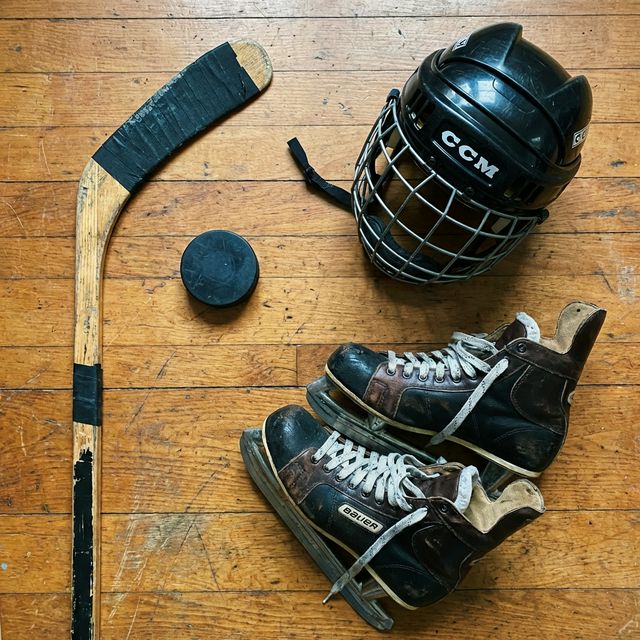
Essential Rules and Equipment
Before you hit the ice or turn on a game, it's good to know the tools of the trade:
- Skates: The footwear with metal blades allowing players to glide across the ice at high speeds.
- Stick: A curved composite/wooden stick used to handle the puck.
- Puck: A solid, vulcanized rubber disk that is frozen before games to reduce bouncing.
- Penalties: If a player breaks a rule (like tripping someone with their stick), they are sent to the "penalty box" for a set amount of time (usually 2 minutes), explicitly forcing their team to play with one less person on the ice. This creates a "Power Play" for the opposing team.
Interactive Tool: Anatomy of a Hockey Rink
One of the biggest hurdles to understanding hockey is the painted lines on the ice. Click on the elements of the rink below to learn what their purpose is in the game!
Click on a highlighted area to learn its rules.
Legal disclaimer
This document is for general information only and is not intended to provide legal, financial or other professional advice. For advice tailored to your particular circumstances, please consult an appropriate professional. We do not guarantee the accuracy, completeness or timeliness of the information, nor should it be construed as an exhaustive discussion of the topics discussed. Opinions expressed are those of the author(s) at the time of writing and may be updated over time. We do not implicitly or explicitly endorse any third parties or their advice, views, information, products or services.